Launch of Indian AI Indus via Sarvam AI
Last updated on April 28, 2026
Something unusual happened at the India AI Impact Summit 2026. In the middle of Bharat Mandapam, Prime Minister Narendra Modi was photographed wearing a sleek, matte-black pair of AI-driven spectacles. They were called Sarvam Kaze, and they had been built by a barely three‑year‑old startup from Bengaluru that just months earlier had been a niche player in Indic language models. The image went viral and made people pause and ask: who exactly built this, and how did they get to the centre of India's AI conversation so quickly?
The answer lies in a launch that took place on February 21, 2026, when Sarvam AI opened limited beta access to Indus — a chat interface powered by a 105‑billion‑parameter sovereign large language model (LLM) . The launch represents India's most ambitious attempt yet to build a home‑grown answer to ChatGPT, Gemini, and Claude .
The Product: What Indus Actually Is
Indus is a voice‑first, multi‑modal conversational AI application that lets users type or speak questions and receive responses in both text and audio. It supports 22 Indian languages along with seamless code‑switching — the natural back‑and‑forth between, say, Hindi and English that dominates everyday Indian conversation . Sign‑in happens through phone number, Google, Microsoft, or Apple accounts. The app is currently available in beta on iOS, Android, and the web, with access so far restricted to Indian users .
Under the hood, Indus runs on Sarvam 105B, a 105‑billion‑parameter model purpose‑trained from scratch in India using the compute infrastructure provided under the Government of India's IndiaAI Mission . A smaller 30‑billion‑parameter variant was also introduced simultaneously, built on a Mixture‑of‑Experts architecture with 2.4 billion active parameters per token and pre‑trained on 16 trillion tokens.
A Closer Look at the Model Stack
Sarvam's 105B model is open‑source and designed to meet most benchmarks, including complex reasoning tasks. Co‑founder Pratyush Kumar stated that the model is on par with most other open and closed frontier models of its class . “This 105 billion parameter model can meet most benchmarks, be it a DeepSeek R1 model that was released a year ago on 600 billion parameters. This was a model trained from scratch, one‑sixth the size of that model and today is providing intelligence which is competitive to what DeepSeek was earlier. It is also cheaper than Google's Gemini Flash but outperforms its many benchmarks,” he added .
The model lineage begins with Sarvam‑1, a 2‑billion‑parameter language model released in late 2024 and trained on a curated corpus of approximately 4 trillion tokens — of which 2 trillion were high‑quality Indic tokens. Sarvam‑1 was optimized for 10 Indian languages and achieved linguistic token‑efficiency (fertility rates) 2–4× better than comparable multilingual models.
The flagship Sarvam‑105B pushes further, with native support for 22 Indian languages and a strong voice‑first orientation . Sarvam claims the model outperforms industry models like Gemini 3 Pro, Opus 4.5, and GPT‑5.2 on Indic language accuracy benchmarks .
The Full‑Stack Bet
Indus is not an isolated chatbot. It is the consumer entry point into a larger sovereign AI stack:
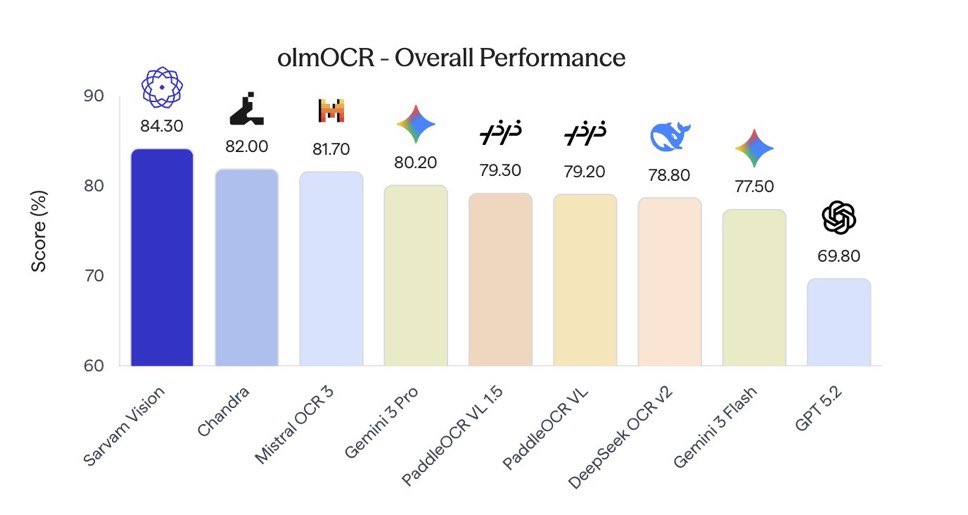
Sarvam Vision & Akshar: A 3‑billion‑parameter vision‑language model plus a document‑intelligence workbench for layout‑aware extraction, visual grounding, and agentic proofreading across 22 Indian languages, including complex manuscripts and diacritics‑heavy scripts .
Saaras V3: Streaming and batch speech‑recognition across 22 Indian languages, trained on over 1 million hours of curated multilingual audio. It achieves ~19.31% WER on the IndicVoices benchmark (top‑10 languages) — lower than those reported for Gemini 3 Pro and other named systems — and 6.37% WER on the Indian‑English Svarah benchmark, with a fast mode targeting <150 ms time‑to‑first‑token .
Sarvam Edge: Fully on‑device inference for speech recognition and synthesis, removing cloud dependency and per‑query costs. The model weighs in at 74 million parameters (~294 MB footprint) and supports 10 Indic languages with automatic language detection .
Sarvam Studio: A workspace for document translation, AI dubbing, and multilingual publishing, with a human‑evaluation study showing higher viewer preference than ElevenLabs, Rask AI, and YouTube Dub .
Sovereign AI: More Than a Tagline
What makes the Indus launch genuinely notable — beyond the product itself — is that it happened under a government mandate. Sarvam AI was among 12 organisations tasked by the Indian government with developing AI models built on Indian datasets, as part of the IndiaAI Mission. The mission provides selected developers with subsidised access to national GPU compute infrastructure and programme support for building sovereign AI . This places Indus squarely within the "Atmanirbhar Bharat" (Self‑Reliant India) framework . The company states its mission clearly: "AI for all from India" .
The idea of "sovereign AI" has become something of a buzzword globally, but Sarvam's definition is concrete: India must own the full stack — foundational models, data, and interface — and must be "a builder and not merely a consumer in this defining era of technology" .
The Backstory: Two Engineers, One Obsession
Sarvam AI was founded in August 2023 by Vivek Raghavan and Pratyush Kumar. The two men are far from first‑time founders chasing a trend. Both hold degrees from IITs and PhDs — Kumar from ETH Zurich, Raghavan from Carnegie Mellon — and spent over a decade embedded inside India's largest digital‑infrastructure projects. Raghavan served as Chief Product Manager and Biometric Architect for Aadhaar, enrolling over a billion people into a unified digital identity system . Kumar co‑founded AI4Bharat, an open‑source initiative built on the conviction that AI developed primarily on English data would always fit India imperfectly . Both men came up inside Nandan Nilekani's orbit and carry the particular worldview of people who believe India's digital infrastructure is its greatest strategic asset .
Within five months of founding, the company had raised $41 million from Lightspeed Venture Partners, Peak XV Partners, and Khosla Ventures . By 2026, the bet has grown drastically: in April 2026, Sarvam was closing a fresh round of $300–350 million at a valuation of roughly $1.5 billion, led by Bessemer Venture Partners with participation from Nvidia, Amazon, and Prosperity7 Ventures.
The Competitive Landscape
India has become one of the fastest‑growing markets for generative AI. OpenAI's Sam Altman recently confirmed that ChatGPT has crossed 100 million weekly active users in India; Anthropic says India accounts for nearly 6% of global Claude usage . Both OpenAI and Anthropic have launched India‑specific benchmarks (IndQA) and infused Indic languages into their models .
Sarvam’s Indus enters this landscape with a sharp differentiator: it is built in India, on Indian data, for Indian users, rather than being a global product adapted to India.
Early‑Stage Limitations
The launch is a beta, and Sarvam has been transparent about the rough edges. Users cannot delete individual chats without deleting the entire account, and there is no setting to disable the reasoning mode, which can occasionally slow down replies . Compute capacity remains constrained, and new users may encounter a waitlist as access gradually widens . Co‑founder Pratyush Kumar addressed this directly, saying: "We're gradually rolling out Indus on a limited compute capacity, so you may hit a waitlist at first. We will expand access over time" .
Within the first few days of launch, the Indus app crossed 10,000 downloads on the Google Play Store .
Enterprise Ambitions & Hardware Partnerships
Beyond consumers, Sarvam is building real‑world channels:
HMD (Nokia): Sarvam is bringing AI to Nokia feature phones, targeting the hundreds of millions of Indian users who do not own smartphones .
Bosch: AI‑enabled automotive applications, embedding voice‑first interfaces into connected vehicles .
Kaze Spectacles: On‑device AI wearables demonstrated at the summit, with PM Modi pictured wearing them .
What the Launch Signals
The Indus launch is not really about a single chatbot app. It represents a thesis — that India does not have to import its AI future wholesale from California. The company frames it as a listening exercise: "Sovereign AI must be built with the country, not just for it" .
Whether that thesis holds will depend on how the market responds, how the model iterates based on user feedback, and whether the underlying economics of compute, data, and distribution work in India's favour. What has changed as of February 21, 2026, is that the question is no longer theoretical. There is a product. It is live. And for the first time, a home‑grown Indian LLM stack is available for users to actually try, break, and improve.
The 2026 India AI Impact Summit gave Sarvam its spotlight. But the real test begins now, in the hands of users who Sarvam hopes will help shape what comes next.
Some data may be wrong. The information is based on general researches in internet. Weniba doesn't guarantee for correctness. Weniba doesn't take responsibility for wrong information.